
I grew up in a predominantly white area in the 90s–a time when being different didn’t feel nearly as celebrated as it does now.
I asked my mom for turkey sandwiches because bringing palak paneer (my favorite) in my lunchbox was embarrassing. Kids would comment on how it looked or smelled.
For a long time, I wanted to blend in.
I think my parents wanted that for me too, at least in part. They wanted me to succeed here. To feel comfortable here. To fit into the world they had chosen to raise me in.
When I went to college and suddenly found myself surrounded by more Indians, something started to shift. South Asian dance groups had the most popular booths at the club fair. Diwali was the biggest celebration on campus. The things that had once made me feel different were suddenly everywhere—and celebrated.
I still remember the night when a friend taught me how to make Maggi in our dorm kitchen. It sounds so ordinary, but there was something freeing about not wondering whether someone would comment on the smell.
For the first time, the things I had spent years feeling self-conscious about became things I felt proud of. And now, as a mother, I want to make sure my daughter grows up connected to something I feel sad that I spent part of my own childhood trying to distance myself from.
So I’ve started thinking of it in three parts. What from our culture I want to keep. What I want to leave behind. And the hardest one — what I want to make into our own version.
What we keep
The easy list came first.
Diwali. Desi clothes. Indian food. Trips to India. Some Hindi or Telugu.
But when I actually sat with it, I realized it’s so much deeper than that.
I don’t just want her to eat Indian food. I want my mom’s biryani and my mother-in-law’s masala dosa to taste like home.
I don’t just want her to celebrate Diwali. I want to create family traditions that become so familiar she couldn’t imagine the holiday without them.
I don’t just want her to hear Hindi or Telugu. I want her to have access to the parts of our family that live in those languages—the jokes and expressions that don’t quite translate.
I want our culture to feel less like something she was taught and more like something she grew up inside.
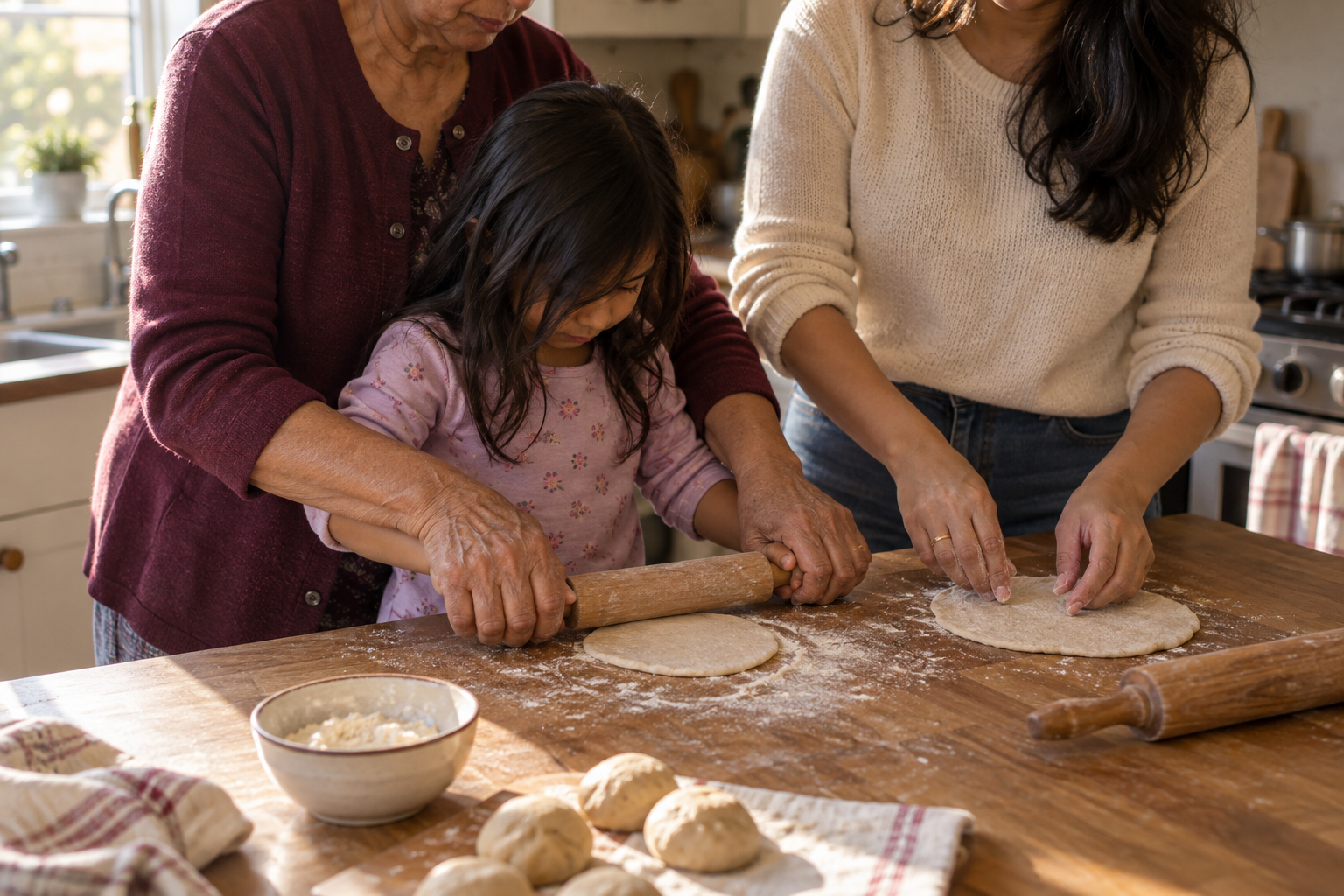
Which is why I’m especially grateful that, unlike me, my daughter gets to grow up with both sets of grandparents in her life. Her grandparents carry memories, language, habits, stories and ways of doing things that I don’t. They probably won’t ever sit down and formally teach her, but she’ll absorb these pieces of her culture simply by being around them.
Some of the most meaningful things get passed down exactly like that. Not teaching them. Not formalizing them. Just living around them.
What we leave behind
But wanting my daughter to feel deeply connected to our culture doesn’t mean I want to pass down every part of it.
We inherit ways of thinking about success, respect, family, obligation—often without even realizing we’ve inherited them. Becoming a parent has made me look at some of those things for the first time and ask: Does this still feel right for the family I’m raising?
Sometimes the answer is no.
The pressure of “what happened to the last point?” when you brought home a 99.
The idea that respect for your elders meant never questioning them.
The weight of log kya kehenge?
I don’t think our parents chose those things any more deliberately than I’m choosing every message I pass to my daughter. They were raising us the way they’d been raised, in a country that was new to them, holding on to what they could.
And I’m sure there are things I’m doing now that my daughter will one day decide she wants to do differently. That’s part of what each generation gets to do.
I’m realizing that doesn’t mean I’m rejecting my culture. I can be grateful for how I was raised, love where I come from, and still decide that not everything needs to be inherited by her.
What we remake
Then there are the things that matter too much to leave behind, but that I can’t—or don’t want to—pass down exactly as I received them.
I want my daughter to grow up with closeness to family and respect her elders, but I also want her to feel comfortable disagreeing with them and setting boundaries.
I want to expose her to religion. but I want her faith to be a choice instead of a set of rituals she’s forced to perform.
I want her to know the kind of love that comes from a grandparent feeding you with their own hands, but I also want her to have the freedom to explore food for herself and build independence and confidence around eating.
I want her to be driven and take her education seriously, but I want her to focus on the 99 points she did score instead of the 1 she didn’t.
For me, that’s what remaking looks like. Keeping the values themselves–family closeness, respect, faith, education–while letting its expression change.
None of us inherit our culture whole. Our parents adapted too. They kept certain traditions and loosened others. English became more important. Fusion meals and pizza nights appeared next to the food they grew up on. We grew up inside whatever version resulted.
Now we’re doing the same thing.
My daughter is growing up in a different America than I did. She has grandparents nearby, a more visible Indian American community, and hopefully a childhood where difference feels less threatening.
I want pav bhaji in her lunchbox to just be lunch.
I want Indian clothes to feel beautiful, not costume-like.
And I want her to feel like she can be fully American and fully Indian without having to decide which side of herself fits the room she happens to be in.
Her version of being Indian was never going to look like mine, the same way mine doesn’t look like my parents’.
That’s how culture survives: each generation deciding what to keep, what to leave behind, and what to remake.